
VSME Voluntary Standard: Scrutiny Ends Without Objection
Update of 23 September 2026. The Voluntary Standard was published in the Official Journal on 21 September 2026 as Delegated Regulation (EU) 2026/1560. It enters into force on 24 September 2026. Read VSME Voluntary Standard published in the Official Journal for the dates that now matter.
A large customer can still ask for a VSME file. What they can no longer do is wait for Brussels to rewrite the standard. That window has closed.
On 3 July 2026 the European Commission adopted delegated regulation C(2026) 5011. It sets a Voluntary Standard based on EFRAG’s VSME, for undertakings that are not in mandatory CSRD reporting. The act then went to the European Parliament and the Council for scrutiny. Under that procedure they could object to the whole act. They could not rewrite individual datapoints.
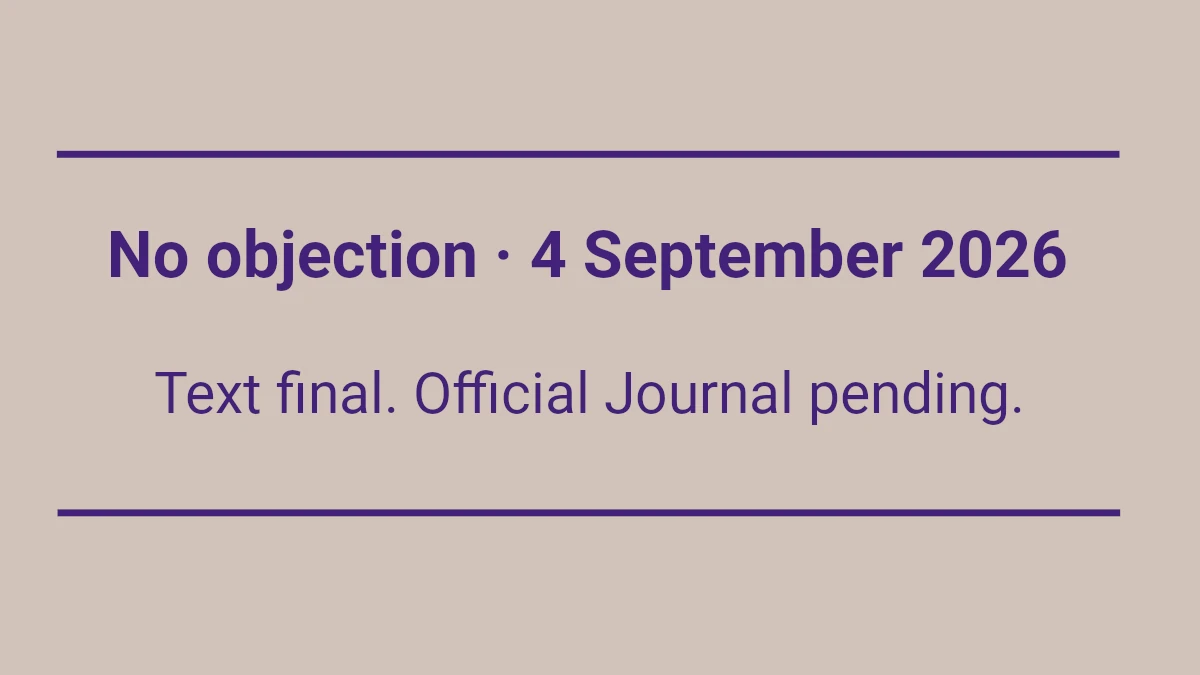
EUR-Lex listed 3 September 2026 as the foreseen end of the two-month objection period. By 4 September 2026 neither institution had objected. The text became final. Only publication in the Official Journal of the European Union remained. That publication followed on 21 September 2026.
This is a dated news note, not a full explainer. For who VSME is for, the two modules and the value-chain cap, read What is VSME?
No objection on 4 September. In force from 24 September.
What closed on 4 September
For a report you are writing this autumn, the political risk was not a rewrite of datapoints line by line. The risk was an objection by Parliament or the Council to the entire act. That objection would have returned the file to the Commission. No such objection arrived.
|
The wording is stable Parliament and Council did not object. They also cannot amend a delegated act of this kind datapoint by datapoint. The Voluntary Standard in C(2026) 5011 is the text that was published as Delegated Regulation (EU) 2026/1560. |
Work on a report is not wasted The Commission kept changes from EFRAG’s VSME to a minimum, mainly to align with the revised ESRS. The Basic and Comprehensive modules and the “if applicable” logic carry over. A report started on this text will not be orphaned by a political rewrite. EFRAG’s digital tools are still due an update for the new standard, expected in the fourth quarter of 2026. Record which taxonomy version the file used. |
Status first checked on 17 September 2026. Updated on 23 September 2026 after Official Journal publication.
What this news is not
| Claim you may hear | Accurate position |
|---|---|
| VSME is now EU law | Since publication on 21 September 2026 it is Delegated Regulation (EU) 2026/1560, in force from 24 September 2026. It establishes a standard for voluntary use, not a reporting duty. |
| SMEs must publish a VSME report | No. The standard remains voluntary. Firms use it because customers, banks, investors or tenders ask for a recognisable file. |
| The 2025 Recommendation has already lapsed | Recommendation (EU) 2025/1710 should be treated as no longer producing legal effects from the date the new regulation enters into force. That date is 24 September 2026. |
| Suppliers can already refuse extra CSRD questionnaires | The value-chain cap in Article 3 of the act applies for financial years beginning on or after 1 January 2027. It limits what a CSRD-reporting customer may require from a protected undertaking with up to 1,000 employees. It does not stop bank questionnaires, tender criteria or voluntary sector surveys. |
What to do with a report in progress
Write down, in the basis of preparation, which text you applied. It may be EFRAG’s 2024 VSME, the 2025 Recommendation or the 2026 Voluntary Standard in Delegated Regulation (EU) 2026/1560. Record the template version. One line now saves an awkward conversation with a bank or an auditor later.
If you are choosing modules, start from how to prepare an ESG report for an SME. For field-level VSME detail, use the practical VSME guide. See the complete example report.
The Official Journal publication has its own note. Read VSME Voluntary Standard published in the Official Journal.
FAQ
Did the European Parliament or the Council object to the VSME delegated act?
No. The Commission adopted C(2026) 5011 on 3 July 2026. EUR-Lex listed 3 September 2026 as the foreseen end of the objection period. By 4 September 2026 neither the Parliament nor the Council had objected.
Is the Voluntary Standard already in force?
It is in force from 24 September 2026. It was published in the Official Journal on 21 September 2026 as Delegated Regulation (EU) 2026/1560. Article 4 sets entry into force on the third day after publication.
Can Parliament still change individual VSME datapoints?
Not in this procedure. For this kind of delegated act the co-legislators may object to the act as a whole. They do not negotiate line by line. With no objection, the Commission text stands.
Does this make VSME mandatory for SMEs?
No. VSME and the 2026 Voluntary Standard remain voluntary. They exist so a smaller company can answer once, in a format a large customer or a bank can recognise. Check your own legal position with a qualified advisor. National rules and sector requirements vary.
Key takeaways
- By 4 September 2026 the scrutiny of C(2026) 5011 had closed without objection. The Voluntary Standard text is final.
- The act was published in the Official Journal on 21 September 2026 as Delegated Regulation (EU) 2026/1560. It is in force from 24 September 2026.
- VSME reporting stays voluntary for SMEs. The value-chain cap becomes operational for financial years from 1 January 2027.
- Record which version of the standard your report used. No further rewrite of the text is coming.
- The full status timeline, modules and cap sit in What is VSME?
Sources
- EUR-Lex: Commission Delegated Regulation (EU) 2026/1560 (published in the Official Journal 21 September 2026)
- Linklaters Sustainable Futures: EU CSRD: revised ESRS and voluntary reporting standard are published in the Official Journal of the EU (21 September 2026)
- EUR-Lex: Commission Delegated Regulation C(2026) 5011 (adopted 3 July 2026; Annex I Voluntary Standard, Annex II value-chain cap datapoints; Article 4 entry into force)
- EUR-Lex: Procedure file for C(2026) 5011 (foreseen end of objection period: 3 September 2026)
- European Commission: Commission adopts revised sustainability reporting standards and a voluntary reporting standard (3 July 2026)
- EFRAG: European Commission publishes delegated act on revised ESRS and voluntary sustainability reporting standard (3 July 2026)
- European Commission: Commission Recommendation (EU) 2025/1710 (30 July 2025)
- Linklaters Sustainable Futures: EU CSRD: Commission adopts revised ESRS and voluntary reporting standard (note added 7 September 2026: scrutiny ended 4 September 2026 with no objections)